Ankle and foot · camera low

Point your foot. Watch the Achilles tendon pull.

The bones of the ankle and foot, the calf muscles and the Achilles tendon, and the muscles that pull your toes up, drawn over your own foot.

Your video stays on your device. Nothing is recorded.
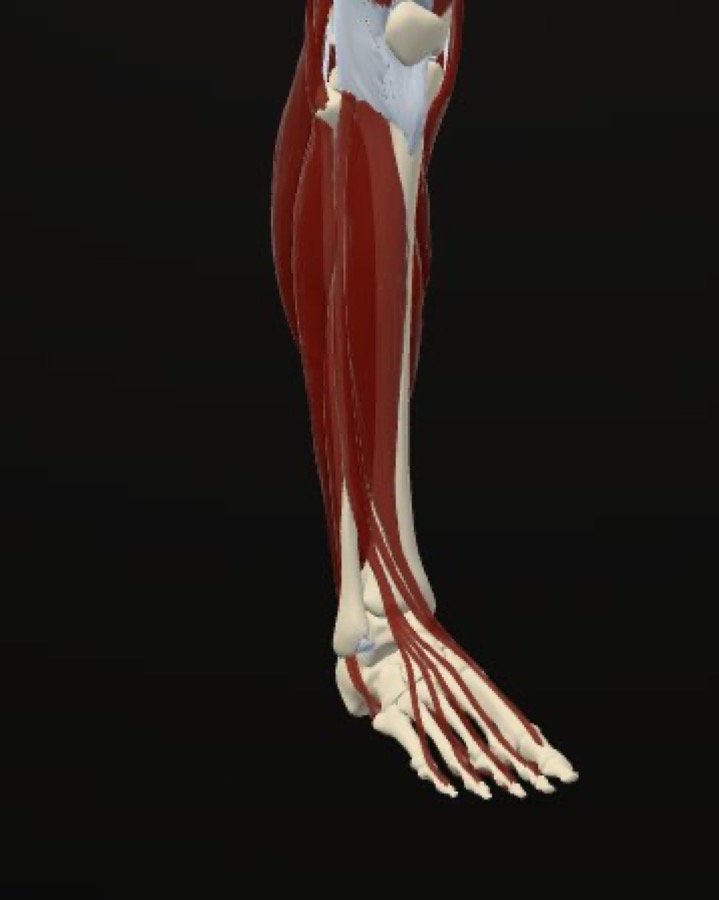
Ankle and foot in the app’s demo: ankle and foot bones, to the toes, the achilles tendon and ankle ligaments

What you will see

  • Ankle and foot bones, to the toes
  • The Achilles tendon and ankle ligaments
  • Calf and shin muscles
  • Arteries and veins of the foot

What the camera follows

Your knee, ankle, heel and the tip of your foot. The foot moves as one piece: the camera cannot see your toes bend.

How to stand

Put the camera low, on the floor or a chair, 1 to 1.5 m away. More below.

What you need

A webcam or a phone you can put low, on the floor or a chair.

How to stand.

The camera has to see the joints it follows. A minute spent on framing saves a lot of jitter.

1–1.5 m, camera on the floor
  1. Put the camera low, on the floor or a chair, 1 to 1.5 m away.
  2. Sit or stand side-on, with your lower leg and foot in view.
  3. Bare feet or close-fitting shoes track best.

Sitting works for pointing and pulling up your foot; stand for the balance experiments.

Three guided experiments.

Each asks for one movement, then explains what happened inside. Spoken narration is optional. Click any structure in the app to read about it.

Open the foot view

  1. 1
    Point and pull up your toesThe ankle hinge and the muscles that work it.
  2. 2
    Stand on one footSmall muscles keep you balanced.
  3. 3
    Rise onto your toesYour whole weight on the Achilles tendon.