Head and face · seated at your desk

Open your jaw. Watch the muscles that move it.

The skull and jaw, the muscles of your face, the blood vessels of your head and neck and the brain, drawn over your own face as you turn, talk and smile.

Your video stays on your device. Nothing is recorded.
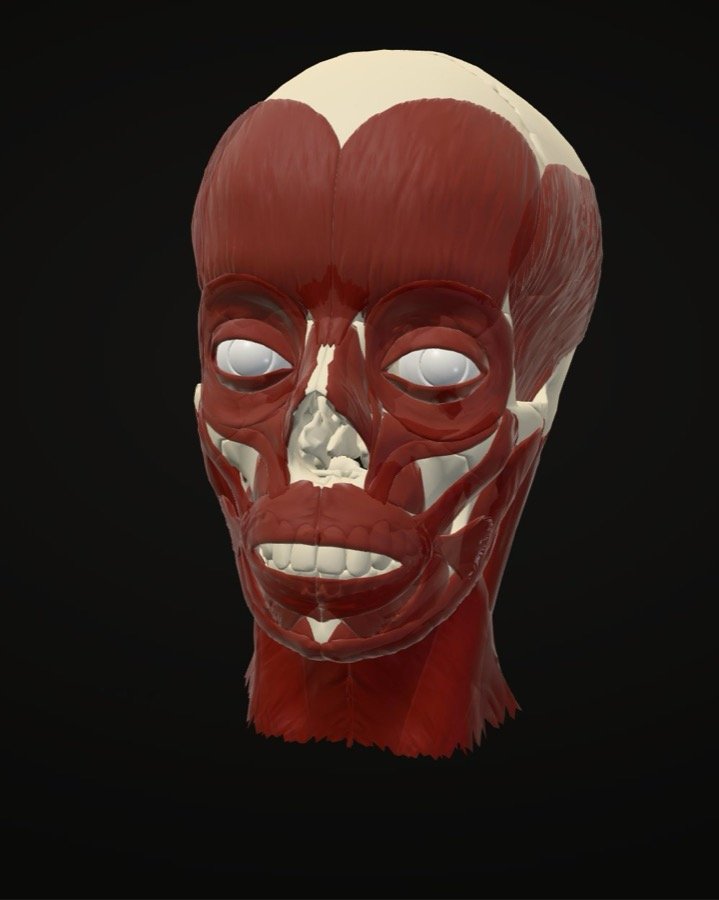
Head and face in the app’s demo: skull and teeth; the jaw opens with yours, muscles of expression and chewing

What you will see

  • Skull and teeth; the jaw opens with yours
  • Muscles of expression and chewing
  • Arteries and veins of the head and neck
  • The brain, inside the skull

What the camera follows

The shape and turn of your face, how far your jaw is open, where your eyes look and your expression. Muscle activity is estimated from your expression.

How to stand

Sit about an arm’s length from the camera. More below.

What you need

A webcam and a desktop browser. Face tracking works like hand tracking: it runs in your browser, saves nothing and does not recognize who you are.

How to stand.

The camera has to see the joints it follows. A minute spent on framing saves a lot of jitter.

40–60 cm
  1. Sit about an arm’s length from the camera.
  2. Face it, with your whole head in view.
  3. Light from in front works best; avoid a bright window behind you.

Glasses are fine. A hat or hair over the forehead can make the fit less steady.

Six guided experiments.

Each asks for one movement, then explains what happened inside. Spoken narration is optional. Click any structure in the app to read about it.

Open the head view

  1. 1
    Open and close your jawSee the jaw joint and the chewing muscles.
  2. 2
    SmileFind the muscles that lift the corners of your mouth.
  3. 3
    Raise and lower your eyebrowsTwo muscles that move your brows in opposite ways.
  4. 4
    Close your eyes tightlyThe ring of muscle around each eye.
  5. 5
    Look left and rightWatch both eyes turn together.
  6. 6
    Puff your cheeksSeal your lips, then blow the air out.